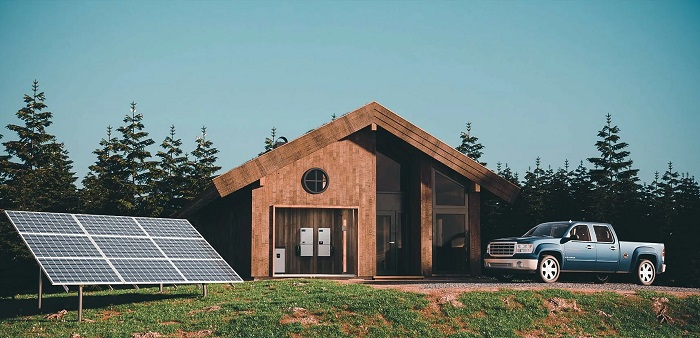
Off-grid living sounds simple until the third cloudy day. Solar panels can produce plenty of energy, but they do not produce it on demand. A home that has no utility connection needs a system designed for both ordinary days and ugly ones.
An off-grid system is usually a small power plant. It needs generation, storage, controls, and often backup fuel. A microgrid is a local electrical system that can operate independently from the main grid. For a remote home, the property itself may become the microgrid.
The Daily Load Is Only Half the Story
The first planning step is a load inventory. Lights, refrigeration, well pumps, internet equipment, cooking, laundry, heating, cooling, and EV charging all need to be counted. The U.S. Energy Information Administration reported that the average U.S. residential customer purchased 10,791 kWh in 2022, but off-grid homes cannot rely on national averages.
The important details are timing and priority. A well pump may only run briefly but require high starting power. A refrigerator runs lightly but often. Electric resistance heat can overwhelm a storage plan. Air conditioning may be manageable in a high-solar climate but difficult in humid regions overnight.
A kilowatt, or kW, describes power at a moment. A kilowatt-hour, or kWh, describes energy over time. Off-grid design needs both.
Storage Must Cover Nights and Bad Weather
Solar battery storage can easily cover evening use if the panels refill it daily. The difficult part is autonomy, which means how long the home can run without meaningful solar recharge.
One day of storage may be fine for a cabin. A full-time residence may need more. A home with medical equipment, a remote work setup, or extreme weather exposure needs a larger safety margin.
NREL and other energy modeling groups often analyze off-grid and hybrid systems by matching renewable production, storage duration, generator runtime, and fuel use. The pattern is consistent: storage reduces generator use, but backup generation may still be valuable when weather stays poor.
That is why ESYsunhome product categories include not only residential all-in-one ESS options but also PV-storage-diesel hybrid systems. The ES130-261 PV-Storage-Diesel Hybrid System, listed at 130 kW / 261 kWh, is not a typical small-home product; it is better understood as a larger hybrid architecture for remote, commercial, or microgrid-style sites. The idea behind it is still useful: solar carries the cheap daily work, batteries smooth and shift energy, and diesel covers rare extended gaps.
The Inverter Is a Comfort Decision
Inverter size affects how the home feels. Too little output and residents learn not to run the microwave, pump, and laundry at the same time. More output creates a smoother experience but can raise cost.
Large homes or three-phase properties may need a system class such as HM10-H, HM15, or HM20, which are listed as three-phase all-in-one ESS models from 10-20 kW and 10-90 kWh. A smaller off-grid residence may be better served by a simpler single-phase system if the loads are disciplined.
Efficiency Comes From Habits Too
Off-grid success is not only hardware. It helps to schedule heavy loads when solar is producing, use efficient appliances, insulate well, and avoid electric resistance heating where possible. Monitoring through an app or cloud platform can make those habits easier because energy use becomes visible.
An off-grid home can run on solar battery storage, but the design must respect weather, seasons, and human behavior. The most reliable systems are not romantic. They are carefully sized, monitored, and honest about backup.