
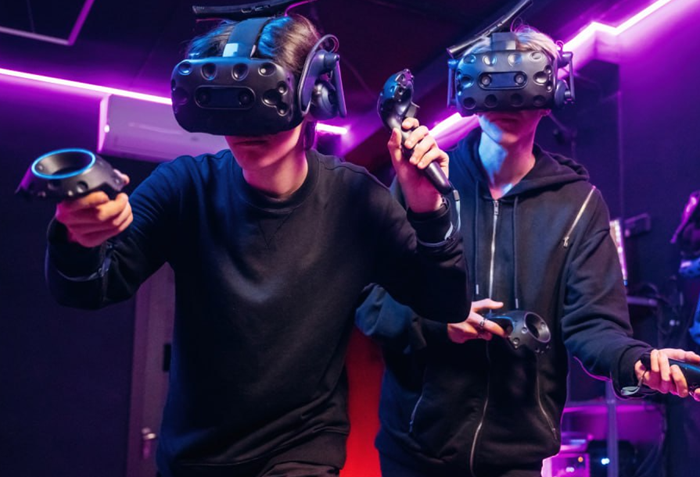
Virtual reality has moved beyond novelty status to become a recognized format for entertainment and training—one capable of supporting a sustainable business.
To launch a start vr arena, it is crucial to define your concept early on (e.g., arcade-style games, team-based shooters, escape rooms, or educational scenarios), assess local demand, and select a location with high foot traffic, convenient logistics, and adequate floor space.
Setting up a VR project begins with budgeting for hardware and software, selecting content tailored to your target audience, and establishing safety protocols—such as spatial zoning, visitor rules, regular headset disinfection, and equipment maintenance. Equally important is devising a business model (hourly rates, memberships, corporate events), a marketing strategy (social media, partnerships, launch promotions), and a service system that encourages repeat visits and word-of-mouth recommendations.
Choosing a Profitable VR Niche
When selecting a VR niche, it is best to start not with the most “impressive” technology, but with clear business logic: who is paying, what exactly are they paying for, and how often? In practice, the most resilient business models are those where VR solves a specific client problem—such as staff training, safety enhancement, reduced onboarding time, pre-production product visualization, or the sale of high-margin experiences.
To quickly filter out weak ideas, evaluate the market demand in your city or region, the frequency of repeat purchases, and customer acquisition costs. For instance, VR entertainment may generate high visitor volume but requires continuous marketing and regular content updates;
Corporate training yields higher contract values, though the sales cycle is longer; success depends on case studies, methodology, and delivering measurable results for the client.
Criteria for a potentially profitable niche
- Solvent clients: B2B (manufacturing, logistics, retail, healthcare, construction) or B2C segments with a high willingness to pay (events, attractions, premium venues).
- Measurable impact: time savings in training, reduced defect/error rates, increased sales conversion, and lower costs associated with business travel and product demonstrations.
- Repeatability: regular training for new hires, module updates, content or service subscriptions, and seasonal events.
- Barriers to entry: expertise in training methodology, 3D production, system integration, and analytics boosts margins and protects against price-cutting competition.
- Operational simplicity: clear use cases, a limited number of devices, and reliable maintenance and sanitation processes.
Before making a final choice, define a single core value proposition and validate it with 10–15 target clients: identify their specific pain points, the budget they currently allocate to alternatives, and their preferred purchasing model—whether it’s one-off development, rental, subscription, or a comprehensive turnkey solution.
Calculating the ROI of a VR project
The easiest way to calculate the payback period for a VR business is by analyzing cash flow and the break-even point: determine your monthly revenue and your fixed versus variable costs. Start by listing your revenue streams (sessions, equipment rental, content development, corporate training, support services) and linking each to measurable metrics: price, number of clients, utilization rate, and average transaction value.
Next, categorize costs into CAPEX (one-time investments) and OPEX (recurring monthly expenses). Investments typically cover VR headsets and PCs/consoles, sensors/accessories, venue fit-out, initial content, and legal/administrative fees. Monthly expenses include rent, salaries, marketing, subscriptions/licenses, utilities, consumables, repairs, and content updates. Don’t forget to account for downtime and seasonality: even prime locations rarely operate at 100% capacity year-round.
- Calculate the margin: revenue minus variable costs associated with service delivery (staff hours, venue/aggregator commissions, consumables, content royalties, transportation).
- Determine the break-even point: divide fixed costs by the margin per sale/session to find the minimum monthly sales volume required.
- Estimate the payback period: divide the initial investment by the projected average monthly profit (after all expenses and taxes).
- Test different scenarios—pessimistic, baseline, and optimistic—varying the utilization rate, pricing, and customer acquisition costs.
To ensure the calculation is realistic, incorporate customer acquisition costs and conversion rates into your model. If marketing is expensive and repeat purchases are low, the project might look profitable on paper but actually face cash flow shortages. A practical approach is to determine an acceptable CAC (acquisition spend) in advance and compare it against the gross profit generated by a customer over the entire engagement lifecycle—including repeat visits, upsells, and corporate renewals.
The final check for profitability is the presence of a “growth lever”: the ability to increase profit not merely by boosting traffic, but also by expanding the product lineup (new scenarios, additional training modules, off-site events), increasing the average transaction value, and reducing costs through process standardization. The more such levers are built in from the start, the more resilient the VR project is to competition and fluctuations in demand.